What answering services actually publish as their prices
Each provider's own published number, with the source link, what the plan covers, and the per-minute arithmetic shown — every figure read directly from the provider's pricing page on August 5, 2026 to August 26, 2026 (each row shows its own date). No averages, no estimates, no "industry typical."
How much does an answering service cost per month?
As of August 5, 2026 to August 26, 2026 (each row shows its own date), from the providers' own pricing pages: published entry plans run from $49/month (Rosie, AI, 250 minutes included) to "starts at" $449/month (Sameday AI) in the AI category, and from $75/month (PATLive, pay-as-you-go) to $300/month (Smith.ai, 30 calls) for live human receptionists — with top published tiers reaching $2,100/month, and one genuine free tier (Smith.ai's AI line, 25 calls). That is a published-price range, not an average: this page prints no "industry typical" figures. Each number below links to the provider page it was read from, with the per-minute arithmetic shown — and the published number is a floor, not a forecast, because overage rates, billable-minute rules, and after-hours premiums are where the real bill gets made.
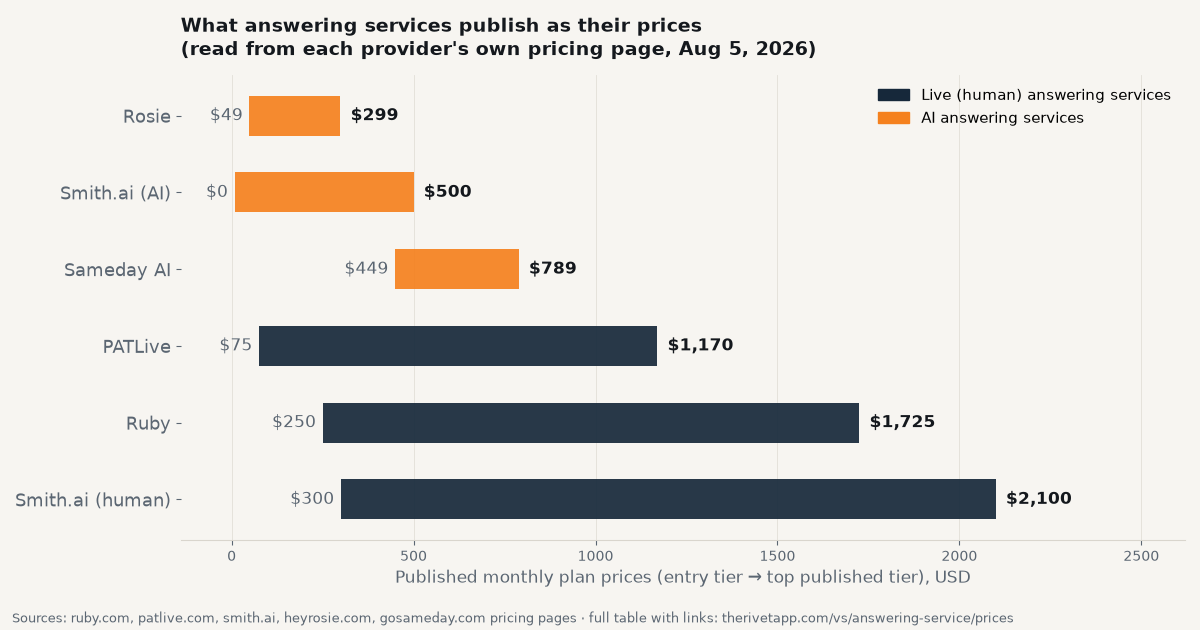
Rivet is deliberately not on that chart. Every bar is a ladder from a provider’s entry plan to its top published tier, and the rungs are bought with minutes or calls. Rivet’s two plans aren’t a ladder of that kind — they are $50/mo and $150/mo, flat, with the same capabilities in both and no meter on either. Drawing $50–$150 as a bar beside those would imply a metered range we don’t sell. Our row is in the AI table below instead, on the same sourcing terms as everyone else’s.
What do live answering services publish as their prices?
As of August 5, 2026 to August 26, 2026 (each row shows its own date), from their own pricing pages: Ruby publishes $250/month for 50 receptionist minutes ($5.00/minute, shown by division) up to $1,725 for 500. PATLive publishes $75/month pay-as-you-go at $2.60/minute, and $250/month for 75 minutes with $2.35/minute overage. Smith.ai publishes $300/month for 30 receptionist calls — $10.00 per call. Source links below; none of these is what you'll ultimately pay, and the reasons are itemized further down.
| Provider | Published price | What it covers | The division, shown | Their page | Read on |
|---|---|---|---|---|---|
| Ruby | $250/mo (Starter) to $1,725/mo | 50 receptionist minutes on the entry plan; up to 500 on the top tier | $250 ÷ 50 min = $5.00/min; $1,725 ÷ 500 = $3.45/min | ruby.com/plans-and-pricing | 2026-08-05 |
| PATLive | $75/mo (pay-as-you-go) to $1,170/mo | Basic has no included minutes at $2.60/min; Starter $250/mo covers 75 min with $2.35/min overage; Pro $1,170/mo covers 600 min | Starter: $250 ÷ 75 min ≈ $3.33/min before overage | patlive.com/pricing | 2026-08-05 |
| Smith.ai (human receptionists) | $300/mo (Starter) to $2,100/mo | 30 calls on the entry plan, up to 300 on Pro; overage $11.50/call on Starter | $300 ÷ 30 calls = $10.00/call | smith.ai/pricing/receptionists | 2026-08-05 |
Why can't you compare those plans side by side directly?
Because the billing unit differs between them. Ruby and PATLive meter in minutes; Smith.ai meters in calls. A $250 plan covering 50 minutes and a $300 plan covering 30 calls cannot be ranked against each other until you know your own call volume and your average call length — a shop taking many short calls and a shop taking few long ones get opposite answers from the same two plans. Every figure above is also the entry shape only: overage rates, after-hours behaviour, and what counts as a billable minute are where the real bill gets made.
What do AI answering services publish as their prices?
As of August 5, 2026 to August 26, 2026 (each row shows its own date), from their own pricing pages: Rosie publishes $49/month for 250 minutes (about $0.20/minute), with appointment booking from its $149 tier. Smith.ai's AI line publishes a free 25-call tier, then $150/month at about $2.00/call. Sameday publishes "starts at $449/month" for 500 minutes (about $0.90/minute). Rivet publishes $50/month and $150/month, flat, with no meter. The AI category meters the same way the human one does — the per-unit price is lower, and the fine print is the same kind of fine print.
| Provider | Published price | What it covers | The division, shown | Their page | Read on |
|---|---|---|---|---|---|
| Rosie | $49/mo (Professional) to $299/mo | 250 minutes on Professional with message-taking; appointment booking and call transfers start on Scale, $149/mo for 1,000 minutes; Growth $299/mo for 2,000; $50/mo website-texting add-on; no overage rate published | $49 ÷ 250 min ≈ $0.20/min; booking tier $149 ÷ 1,000 ≈ $0.15/min | heyrosie.com/pricing | 2026-08-26 |
| Smith.ai (AI receptionist) | $0/mo (25 calls) to $500/mo | Free tier covers 25 calls then $3.00/call; Pro $150/mo at ~$2.00/call; Enterprise $500/mo at ~$1.67/call | Their own stated rate: $2.00/call on Pro | smith.ai/pricing/ai-receptionist | 2026-08-05 |
| Sameday AI | “Starts at” $449/mo to $789/mo+ | 500 minutes, unlimited users and 3 locations on Launch; 1,000 minutes and unlimited locations on Scale; Enterprise custom; no overage, setup or contract terms published | $449 ÷ 500 min ≈ $0.90/min | sameday.ai/pricing | 2026-08-26 |
| Rivet (us) | $50/mo (Basic), $150/mo (Enterprise) | The whole loop in both plans — answers, books the job, then drafts the quote, invoice and follow-up as proposals you approve. Basic is owner plus one; Enterprise covers up to five people and adds QuickBooks overnight sync. | No per-minute or per-call meter, so there is no division to show — a busy month bills the same as a quiet one. | therivetapp.com/pricing | 2026-09-15 |
Why do AI answering services vary so much in price?
Because they are priced for different buyers, not because one is nine times better. Rosie's entry plan and Sameday's entry plan differ by 9× — $49 against $449 — and the spread inside the AI category is wider than the spread between the AI and human categories. Sameday positions itself at multi-truck operations already running field-service platforms; Rosie positions itself at any small business. Which vendors should even be quoting a one-person shop is half of the buying decision, and it is a question about fit rather than about price.
If you are sizing this for a shop that is still getting off the ground, the entry tiers are the only rows that matter — and the overage rate attached to them matters more than the headline.
Which providers publish no price at all?
Several of the biggest names publish no usable number: Avoca's pricing is quote-based with no public price list. AnswerConnect's and AnswerForce's figures vary by configuration and weren't stated as a simple public plan card when we checked. VoiceNation is mid-consolidation into Moneypenny, so its plan structure is in transition. Housecall Pro sells its CSR AI add-on separately without publishing what it costs. The absence of a published price is itself information: it usually means the price depends on a sales conversation.
Rivet was on that list until 2026-09-15. We gave the number on a call instead of publishing it, and the reasoning — that a quote we could stand behind beat a figure we’d have to caveat — is the same reasoning every vendor above would give. It still amounted to making you ask. Both plans are now on the pricing page and in the table above, held to the terms we hold everyone else to: our number, our page, the date it was read.
So the claim this page makes is still the narrow, checkable one: every figure above is real, sourced and dated under our editorial standards — and the shape of the bill differs. A meter scales with your busiest month; a flat price doesn't.
For the named comparisons, we've written the honest head-to-heads: Rivet vs. Ruby, Rivet vs. VoiceNation, and Rivet vs. Avoca — each including when the other choice is the better one.
Why is the published number never what you pay?
Four mechanisms, all structural: overage rates kick in above the included allotment, and busy months are exactly when you exceed it. Per-minute billing rounds and runs on every call, including wrong numbers and robocalls. After-hours and holiday coverage can carry premiums or plan-tier requirements. And per-call pricing treats a 30-second robocall and a 12-minute emergency intake as the same unit. None of this is dishonesty — human operator time really does cost money — but it means the plan-card number is the floor, not the forecast.
The honest way to forecast a real bill: pull last month's call log, count calls and total minutes, then apply the rates quoted to you — including the overage rate, which is the number that actually governs a seasonal trade's August. We walk that exercise, with the arithmetic written out, in what an answering service actually costs a contractor. The other side of the same ledger — what the calls you currently miss are worth — is the missed-call cost calculator, where every input is your own. If the price question is really a trust question — will an AI book the wrong job? — read does AI answer your phone badly? before you compare anyone's number. And the four mechanisms that make a bill beat its quote — overage, the billable minute, premiums, the per-call unit — are each worked on the numbers above in why your answering service bill comes in higher than the quote.
Common questions
How current are the prices on this page?
Every figure was read directly from the provider's own pricing page on August 5, 2026 to August 26, 2026 (each row shows its own date), and each row links to that page. We re-verify quarterly, as set out in our editorial standards at /editorial-standards. If a linked page shows a different number than this table, their page wins — prices move, and the source link is there precisely so you can check us.
Why do you show the per-minute division instead of just the plan price?
Because plans hide the unit. $250 for 50 minutes and $250 for 75 minutes look identical on a plan card and differ by 50% per minute. Showing the division ($250 ÷ 50 = $5.00/min) keeps the arithmetic checkable and makes plans with different allotments comparable.
What does Rivet cost compared to these?
Rivet is two flat monthly plans for the whole shop, $50/mo and $150/mo — no per-minute or per-call meter, no per-truck fees. We won't print a comparison we can't source both sides of; get their quote and put it beside ours for your own call volume.
Why isn't AnswerConnect or AnswerForce in the table?
The table only carries figures we could read on a provider's own public pricing page on the observation date, stated as a simple plan card. Providers whose pricing is quote-shaped or in transition are listed in the no-published-price section instead — printing a secondhand number would defeat the point of the page.
A flat price, and the phone answered
Rivet answers, books the job, and drafts the invoice — nothing sends without your yes. One monthly price.
Flat monthly pricing from $50/mo · no per-minute meter · no per-truck fees · cancel any time