What one missed call costs a painting contractor
What does one missed call cost a painter?
In painting the missed call is a missed estimate request, so the honest math runs through your quote pipeline: requests × your close rate × your average job, minus the callers you win back. With an $1,800 average job, losing about one job every two weeks to unanswered calls is roughly $46,800 a year. An example to argue with, not a benchmark.
This post is deliberately not the HVAC arithmetic with the words swapped. A furnace call is dispatch-now: answer, book, roll a truck. A painting call is quote-then-schedule: the caller wants a walkthrough and an estimate, usually from two or three shops, and the job lands weeks later. That changes what a missed call costs — and it makes the phone matter more, not less, because in a compare-three-bids trade, being the shop that answered first is a real advantage that costs nothing but the pickup. The missed-call cost calculator opens with painting starting points — all editable guesses, not claims about your book.
What does the math look like, honestly?
One fully worked example, every assumption adjustable: three missed calls a week, a quarter of them jobs you'd have won, a quarter of those recovered by calling back, and an $1,800 average job. That's about 0.56 lost jobs a week — one every two weeks or so — roughly $1,012 a week, $4,390 a month, $52,700 over a year.
The pipeline version has one extra step, so it's worth showing how it folds into the calculator's sliders. Written out:
- 3 missed calls a week, and suppose 2 were genuine estimate requests. At a 40% close rate, that's 0.8 jobs sitting in the missed pile — which is the same as saying about 25% of missed calls were jobs you'd have won. That 25% is the “share that were real jobs” slider.
- You call back that evening and save a quarter of them, leaving about 0.56 lost jobs a week — one every couple of weeks.
- 0.56 lost jobs × $1,800 average job ≈ $1,012 a week.
- A month is 52 ÷ 12 ≈ 4.33 weeks, so about $4,390 a month — and roughly $52,700 over a year.
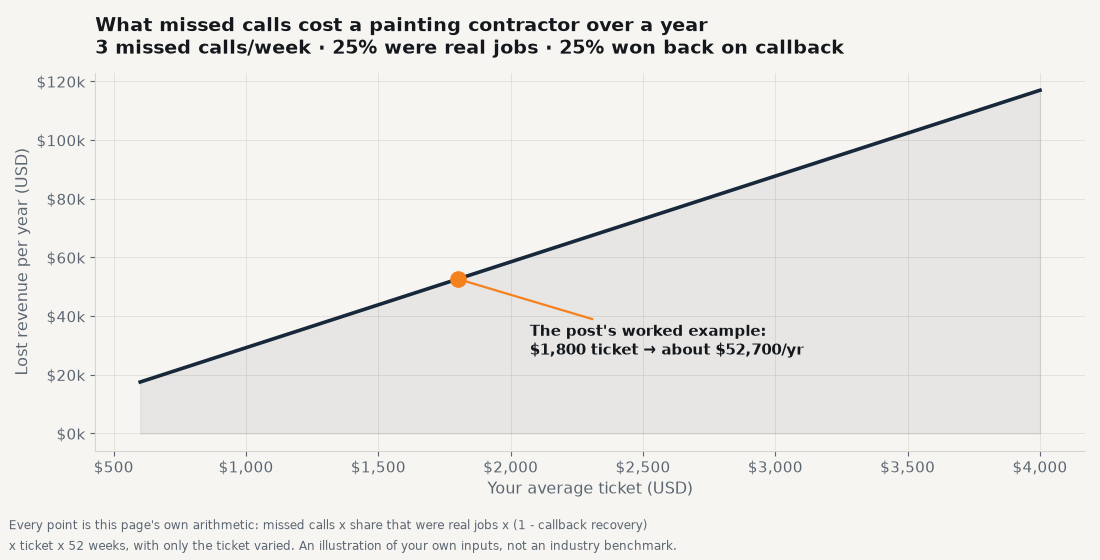
That yearly figure looks dramatic next to the service trades, and the reason is honest: painting jobs are big. Losing one $1,800 job a month is $21,600 a year all by itself. Argue with every input — your average exterior runs $4,500, or your close rate is 60% because you only quote referrals, or you miss one call a week, not three. The calculator starts from exactly these defaults and lets you drag each one to your reality.
Why does answering first matter so much in a quoted trade?
Because the estimate request is the top of a funnel you can't refill later. The homeowner calling three painters books walkthroughs in the order shops respond. Answer first and you get the first slot, set the reference bid, and sometimes close before the second painter calls back. Miss the call and your bid — if you ever give one — arrives last, anchored against someone else's number.
This is the painting-specific texture: there's no emergency premium like a burst pipe, but there is a queue-position premium, and it compounds quietly. The caller who reaches voicemail doesn't leave a message and wait — most just dial the next result. And unlike a service trade, you rarely see the loss: the job happens six weeks later on someone else's schedule, and your phone log just shows a number that never called back. The win-back slider deserves your skepticism here: an evening callback can still land the walkthrough, but you're now second in line, and second quote at the kitchen table closes at a different rate than first.
What does catching the call actually require?
For a painter: the call answered, the walkthrough booked into a real slot, and the homeowner confirmed — while they're still holding the phone and haven't dialed the next shop. Voicemail does none of that. A message-taking service answers politely and leaves the callback and the booking to your evening, which is where queue position goes to die.
The comparison is architectural, same as every trade. A human answering service genuinely beats voicemail — the caller talks to a person, and the request doesn't evaporate. But the deliverable is a message, and in a quoted trade a message means the walkthrough isn't booked and the queue moved on. We lay out that trade-off, including when the human service is the better choice, in AI vs. an answering service, with the category's published prices — sourced and dated — in what answering services actually publish as their prices.
Rivet's approach: answer as your shop while you're on the ladder, book the walkthrough against your real calendar, and draft the confirmation text — all as a typed proposal that sends nothing until you tap approve, with a second supervisor AI checking every proposal and one-tap undo. One honest caveat we keep making: our models are deepest in HVAC, plumbing, and electrical today, and the painting-specific story — including what that caveat means in practice — is at Rivet for painting contractors. Rivet is in early access, so you can put it on your own line and check this post's arithmetic against a real week.
Common questions
How much does a missed call cost a painting contractor?
In painting, a missed call is usually a missed estimate request, so the cost runs through your pipeline: requests × your close rate × your average job. With a $1,800 average job, losing roughly one job every two weeks to unanswered calls is about $46,800 a year. That's an example to audit, not a statistic — run your own numbers in the calculator.
Why is a missed call worse for painters than the ticket suggests?
Because painting jobs are quoted, not dispatched: the caller is early in a compare-three-bids process, and the painter who answers first usually gets the first walkthrough slot. Missing the call doesn't just risk one job — it hands the front of the queue to a competitor for a job that's often four figures.
How do I count my shop's missed calls?
Open your phone's call log for the last seven days and count the calls you didn't answer — including the ones that rang while you were cutting in a ceiling line or up a ladder. That one-week count from your own log beats any published industry average as a calculator input.
- Starting out on your own as a painter: the first year of admin
- Answering services for painters, compared — with prices
- Run the numbers with painting starting points
- AI vs. an answering service for contractors
- Rivet for painting contractors
- The plumbing version of this arithmetic
- The HVAC version of this arithmetic
- The electrical version of this arithmetic
- What an answering service actually costs a contractor
- Does AI answer your phone badly? The honest failure-mode read
Occasional posts on running a one-truck shop — no drip sequence, no sales follow-up, unsubscribe any time.