What one missed call costs an electrical contractor
What does one missed call cost an electrician?
Your average ticket times the odds the call was a real job you lost — arithmetic, not a statistic. With a $450 average ticket for service and panel work and a coin-flip chance the caller had real work, a missed call prices out around $225 before win-backs. There is no honest universal number; run your own week in the calculator.
The worked example below deliberately uses a service-call shape — troubleshooting, small panel work, added circuits — not a full-rewire ticket, because averaging a $12,000 rewire into your “typical call” makes the arithmetic read false. The three inputs all live in your call log and invoices: how often the phone rings out, how many of those callers had real work, and what an ordinary booked job pays you. The missed-call cost calculator opens with electrical starting points — all of them editable guesses, not claims about your book.
What does the math look like, honestly?
One fully worked example — an example, not a benchmark, every assumption adjustable: four missed calls a week, half of them real jobs, a quarter won back on callback, and a $450 average ticket. That's 1.5 lost jobs and about $675 a week — roughly $35,100 over a year.
Written out so you can audit every step:
- 4 missed calls a week × 50% that were real jobs = 2 real jobs in the missed pile.
- You call back and win 25% of those anyway, leaving 1.5 lost jobs a week.
- 1.5 lost jobs × $450 average ticket = $675 a week.
- A month is 52 ÷ 12 ≈ 4.33 weeks, so about $2,925 a month — and roughly $35,100 over a year.
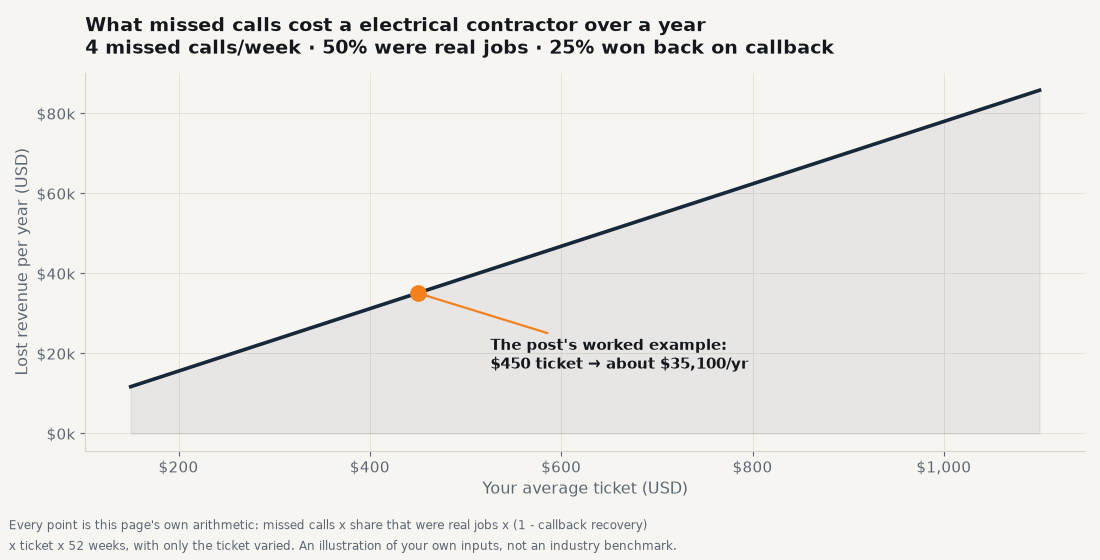
Every line is an assumption to argue with. Your service calls average $300, not $450? Take a third off. You're booked solid on new-construction subcontract work and the missed callers were mostly tire-kickers? Drop the real-job share and watch the number shrink — that's the honest outcome, not a failure of the exercise. The point is that it's your multiplication, on the back of an invoice, and the calculator lets you drag every input to your reality.
Why does electrical work make the phone unanswerable?
Because the trade demands both hands and your whole head. Nobody answers a phone with the panel cover off, halfway through a ceiling-fan brace, or twenty feet up. Electrical's missed calls cluster inside the workday — which means the calls go to voicemail during exactly the hours homeowners and GCs are calling around, and the next electrician in the results picks up.
That's the electrical-specific texture the generic missed-call math misses. An HVAC shop's missed calls spike after hours in a heat wave; an electrician's are a Tuesday-at-10am problem, because the job in front of you is not one you step away from. The practical consequence: “I'll call everyone back at 5pm” is a real system, and it works on patient callers — but a GC filling a slot for tomorrow and a homeowner with half the kitchen dead are not patient callers. When you run the calculator, be honest about the win-back slider: the callers you most wanted are the ones least likely to still be available at 5pm.
What does catching the call actually require?
Three things while the caller is still warm: the call answered, the job booked into a real slot, and the customer confirmed. Voicemail does none of them. A message-taking service does the first and leaves you the callback, the booking, and the confirmation — the second shift after the tools are down.
The comparison worth making is architectural. A human answering service beats voicemail: someone polite captures “half the kitchen outlets are dead, here's my number.” But the deliverable is a message, and a message is a to-do with your name on it. We walk that trade-off, including when the human service is genuinely the better choice, in AI vs. an answering service, and the category's published prices — sourced, dated, and divided out per minute — in what answering services actually publish as their prices.
Rivet's approach is to do all three steps and wait for your yes. It answers as your shop while you're in the panel, books against your real calendar, and drafts the confirmation — as a typed proposal on your phone that sends nothing until you approve it, with a second supervisor AI checking every proposal and a full audit trail with one-tap undo. The electrical-specific version of that story is at Rivet for electrical contractors. Rivet is in early access — put it on your own line and check this post's arithmetic against a real week.
Common questions
How much does a missed call cost an electrical contractor?
Your average ticket times the odds the caller had real work, minus the ones you win back on callback. With a $450 average service-and-panel-work ticket and half of missed calls being real jobs, one missed call prices out around $225 before win-backs. There's no honest universal number — run your own week through the calculator.
Why do electricians miss calls mid-job rather than after hours?
Because the work takes both hands and your full attention. You don't answer a phone in a panel with the mains exposed, in an attic run, or on a ladder — and you shouldn't. Electrical's missed calls cluster inside working hours, which means voicemail is fielding your calls at exactly the times customers are calling around for an electrician.
How do I count my shop's missed calls?
Open your phone's call log for the last seven days and count the calls you didn't answer — including the ones that rang while you were on the tools with gloves on. That one-week count from your own log is a better calculator input than any published average.
- After-hours answering for electricians — which calls are emergencies
- Going independent as an electrician: the first year of admin
- Run the numbers with electrical starting points
- AI vs. an answering service for contractors
- Rivet for electrical contractors
- The plumbing version of this arithmetic
- The HVAC version of this arithmetic
- The painting version of this arithmetic
- What an answering service actually costs a contractor
- Does AI answer your phone badly? The honest failure-mode read
Occasional posts on running a one-truck shop — no drip sequence, no sales follow-up, unsubscribe any time.