What one missed call costs a plumbing shop
What does one missed call cost a plumber?
Your average ticket times the odds the call was a real job you lost — arithmetic, not a statistic. With a $325 average service ticket and a coin-flip chance the caller had real work, a missed call prices out around $160 before win-backs. There is no honest universal number; run your own week in the calculator.
Most “plumbers lose $X per missed call” figures floating around are marketing dressed up as research, and we'd rather hand you the multiplication. The inputs are three numbers that live in your own call log and invoices: how often the phone rings out, how many of those callers had real work, and what your average job pays. The missed-call cost calculator opens with plumbing starting points — every one of them an editable guess, not a claim about your shop.
What does the math look like, honestly?
One fully worked example — an example, not a benchmark, every assumption adjustable: five missed calls a week, half of them real jobs, a quarter won back on callback, and a $325 average ticket. That's about 1.9 lost jobs and roughly $609 a week — around $31,700 over a year.
Written out so you can audit every step:
- 5 missed calls a week × 50% that were real jobs = 2.5 real jobs in the missed pile.
- You call back and win 25% of those anyway, leaving about 1.9 lost jobs a week.
- 1.9 lost jobs × $325 average ticket ≈ $609 a week.
- A month is 52 ÷ 12 ≈ 4.33 weeks, so roughly $2,640 a month — and about $31,700 over a year.
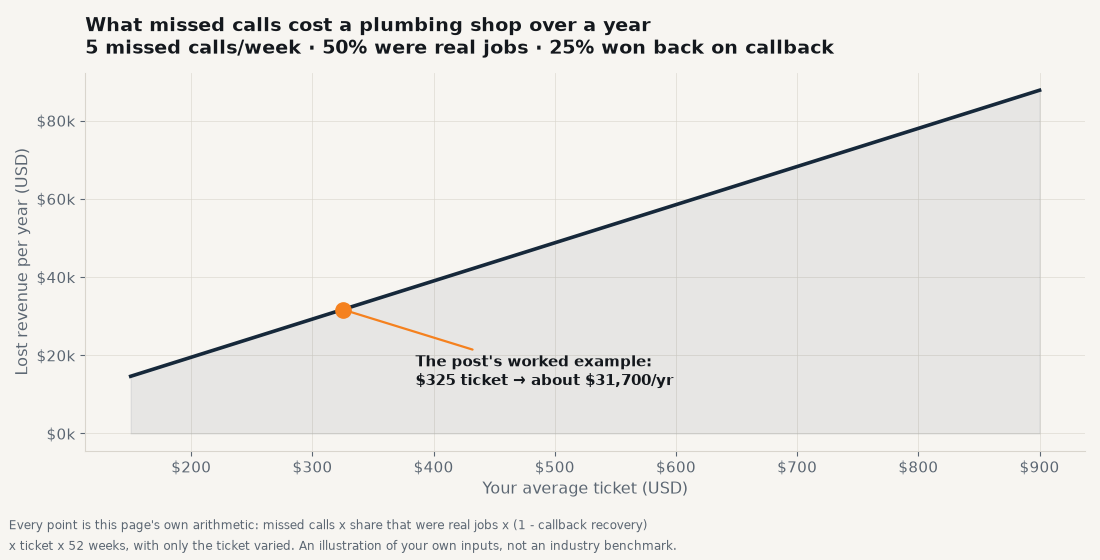
Argue with every number in that chain — that's what it's for. Your service tickets run $250? The total drops by a quarter. You do repipes and water heaters, so the average blends toward $800? It more than doubles. Miss two calls a week instead of five and it falls by more than half. The calculator starts from exactly these defaults and lets you drag each one to your reality.
Why is plumbing's version of this math meaner than most trades?
Because the highest-value plumbing calls are the urgent ones, and urgency kills the callback. A slow drain can wait for your 5pm callback; water coming through a ceiling cannot. The emergency caller dials the next number in the results, which means your win-back rate is lowest on exactly the calls with the biggest tickets — the average hides that.
That's the one plumbing-specific correction worth making to the generic arithmetic. The 25% win-back assumption in the example is a blend: on routine work it might be 40%, on emergencies it rounds toward zero, because the homeowner with a burst supply line hired whoever picked up. If a meaningful share of your revenue is emergency work, run the calculator twice — once with your routine numbers, once with your after-hours week — and notice which one hurts. It's also why the calls that ring out while you're under a sink with both wrists in the trap are the expensive ones: you were unreachable at precisely the moment the most motivated caller in your week was choosing a plumber.
What does catching the call actually require?
Three things while the caller is still warm: the call answered, the job booked into a real slot, and the customer confirmed. Voicemail does none of them. A message-taking service does the first and leaves the callback, the booking, and the confirmation to your evening — which, for an urgent caller, is usually too late.
This is the honest lens for comparing fixes. A human answering service genuinely beats voicemail — a polite operator captures the name, the number, and “water heater, no hot water since this morning” — but the deliverable is a message, and for the emergency caller a message is a race you've already lost. We lay out that architecture, including when the human service is the better choice, in AI vs. an answering service, and the category's published prices, sourced and dated, in what answering services actually publish as their prices.
Rivet's approach is to do all three steps and then wait for you. It answers as your shop, hears “water everywhere” and treats it like the today-call it is, books against your real calendar, and drafts the confirmation — all as a typed proposal on your phone. Nothing sends until you tap approve, a second supervisor AI checks every proposal first, and there's a full audit trail with one-tap undo. The plumbing-specific version of that story is at Rivet for plumbing shops. Rivet is in early access, so you can put it on your own line and check this post's arithmetic against a real week.
Common questions
How much does a missed call cost a plumbing shop?
Your average ticket times the odds the caller had real work, minus the ones you win back by calling back. With a $325 average service ticket and a coin-flip chance the call was a real job, one missed call prices out around $160 before win-backs. There is no honest universal number — run a real week from your own call log through the calculator.
Why do missed calls hit plumbers harder after hours?
Because a real share of plumbing demand is urgent: a burst supply line at 9pm doesn't wait for a callback, it calls the next number in the search results. Urgency compresses the window where a callback can still win the job — which in the arithmetic means a lower win-back rate on exactly the highest-value calls.
How do I count my shop's missed calls?
Open your phone's call log for the last seven days and count the calls you didn't answer — including after-hours calls and the ones that rang out while you were under a sink or on another line. That one-week count from your own log beats any published industry average as a calculator input.
- After-hours answering for plumbers — what gets the 2am call booked
- AI for plumbers: an honest 2026 playbook
- Run the numbers with plumbing starting points
- AI vs. an answering service for contractors
- Rivet for plumbing shops
- The HVAC version of this arithmetic
- The electrical version of this arithmetic
- The painting version of this arithmetic
- What an answering service actually costs a contractor
- Does AI answer your phone badly? The honest failure-mode read
Occasional posts on running a one-truck shop — no drip sequence, no sales follow-up, unsubscribe any time.